Some of our favorite conversations happen in our AI vs. Designer series, where we give the same branding project to an AI tool and to one of our designers, then put the results side by side. This round, the featured client was Cedar & Spice, a Madison, Wisconsin-based design and fabrication studio creating bold, experiential installations for events, brands, and celebrations.
This round came out a little differently than past rounds. AI produced something that, at first glance, looks pretty similar to the final branding we created. Same general color family, same retro-leaning vibe, same general layout of a logo, palette, and business card. And that's exactly why this round is worth a closer look. When the output looks close, the differences that actually matter get harder to see. So let's walk through both.
The Brief: One Project, Two Very Different Processes
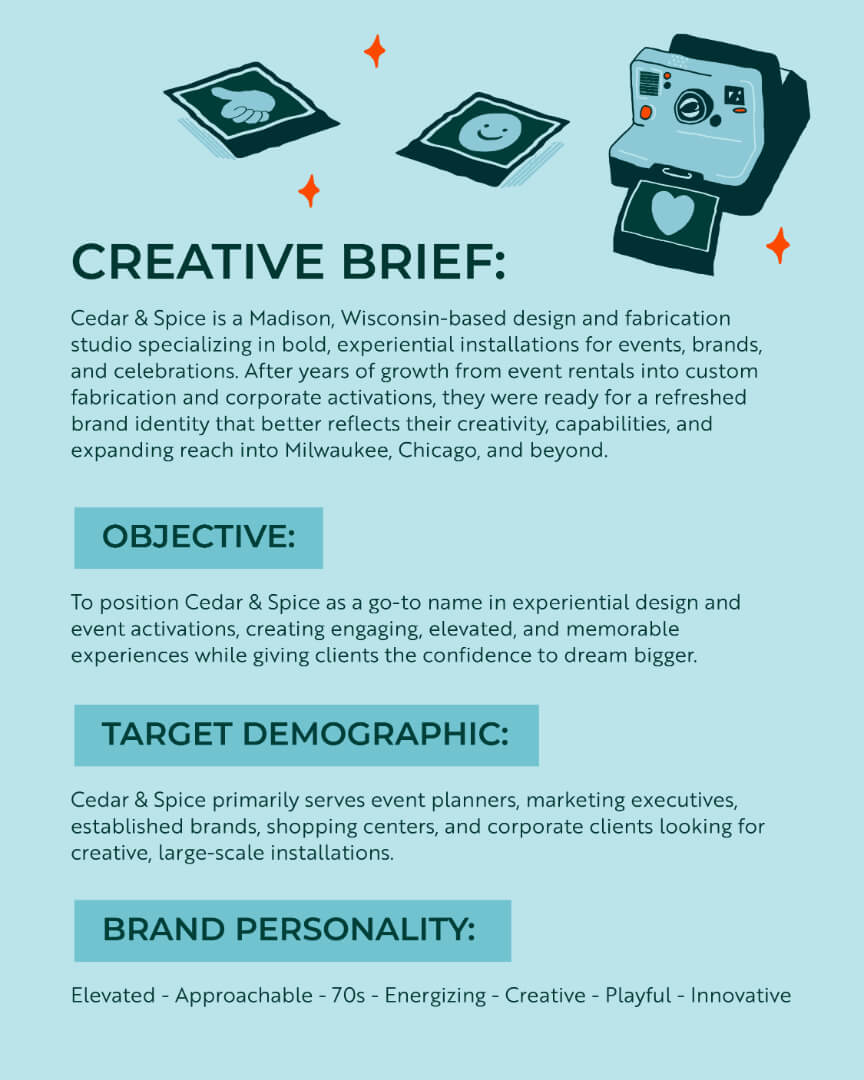
We started both versions from the same creative brief. Cedar & Spice grew from event rentals into custom fabrication and corporate activations, and they were ready for a refreshed identity that reflects their creativity, their expanded capabilities, and their growing reach into Milwaukee, Chicago, and beyond. The goal was to position them as a go-to name in experiential design, serving event planners, marketing executives, established brands, shopping centers, and corporate clients. The brand personality we were designing toward: elevated, approachable, 70s-inspired, energizing, creative, playful, and innovative.
That brief is doing a lot of work. It's not just "make a logo." It's a positioning document that every design decision has to align with.
What ChatGPT Produced

To be fair to the AI, the output is decent. It generated a logo with a retro arch illustration, a five-color palette with named swatches, and a business card mockup. If you scrolled past it on a feed, you might not think twice.
But look closer and the cracks show up fast. The result is a single visual style with no system behind it. The iconography is unclear, the illustration doesn't connect to anything Cedar & Spice actually does, and the type pairing fights with itself. There's one logo, one lockup, one way to use it. There's no answer for how this brand shows up on a sign versus a sticker versus a website header. And there's no strategy underneath any of it, no rationale for why these colors or this mark fit this specific company and the clients they're trying to win.
That's the pattern we see over and over with AI branding: it produces something that looks like a logo, but a logo is not a brand.
What Our Designer Produced
Our designer started from the same brief and built a complete identity system. The primary logo builds on the brand's existing recognition and heritage while bringing it into a more sophisticated, elevated space. A bold serif wordmark with an oversized ampersand, set in an earthy olive green. Retro-inspired colors add nostalgia and character while keeping the whole thing refined and distinctive.
Then came the parts AI never even attempts. Secondary logo variations, including a stacked version and a single-line version with the tagline, give the brand flexibility across different spaces, formats, and touchpoints without losing personality. A badge style featuring the stylized C&S monogram gives the brand a more playful, approachable expression for stickers, stamps, and merch while maintaining its sophisticated aesthetic. The vintage-inspired color palette was built with full CMYK, RGB, and HEX values specified for every swatch, so the brand prints correctly on paper, displays correctly on screens, and stays consistent everywhere it appears.
From there, the system rolled out across a full website design, stationery, envelope branding, and mobile mockups, all carrying the same voice. Every asset traces back to the brief.


The Real Difference: A Logo vs. a Brand System
Here's the honest takeaway from this round. AI can now produce something that resembles a
finished brand, and pretending otherwise would be dishonest.
When you compare the two side by side, the difference is what each one equips you to do next. AI produces a single visual style, unclear iconography, and limited flexibility for how the brand can actually be used. A designer produces a complete identity system with the flexibility and file types you need to use your brand anywhere, from digital to print, signage, merchandise, and beyond. One gives you an image. The other gives you infrastructure.
There's also the question of strategy. Our designer made deliberate choices based on Cedar & Spice's history, their audience of event planners and corporate clients, and their goal of expanding into new markets. Every one of those decisions can be explained, defended, and evolved. An AI output can't tell you why it made its choices, because it didn't make any.
And, to steal a little inspiration from Cedar & Spice themselves: we're good humans, not robots. Working with a real designer means working with someone who asks questions, pushes back, and cares whether the brand actually works in the wild.
Build a Brand People Remember
Your brand should be able to grow and evolve right alongside your business. If you're ready to see what human strategy brings to the table, we'd love to talk.